Why Twitter is changing the world.
21 OctSome considered Twitter a fad earlier this year. Today, it is a force to be reckoned with.
Twitter’s estimate worth is $1 billion. In February 2008, Twitter was hovering around 475,000 users. eMarketer did research earlier this year and estimated there would be 18 million users by the end of 2009. They were way off! By the end of August 2009, there were 27 million users. And there are no signs it is slowing down any time soon. With Google and Bing adding Tweets to the search results, it means Twitter is here to stay.
How will Twitter deal with the mass number of tweets and maintain Twitter so it’s accessible? At any given time so many people are tweeting, it’s common to see this image when you are trying to tweet.

Twitter is over capacity
And as of today, October 20, 2009, Twitter surpassed 5 billion tweets.
So what are people tweeting about? Someone are talking about themselves. This group of “Meformers” makes up roughly 80% of Twitter users according to a study done by Rutgers University. Meformers generally post updates their everyday lives, feelings, and thoughts. The remaining 20% of users are known as “Informers” and they like sharing information and usually include links to their sources.
The Rutgers research determined 9 different types of tweets:
- information sharing (i.e. 5 WordPress plug-ins to try out + URL)
- self promotion (i.e. Check out Arnold DC’s latest work +URL)
- opinions and complaints (i.e. I love Amtrak!!) Best person to follow on Twitter for this is @shitmydadsays
- statements and random thoughts (i.e. Ever wonder why dogs like cat food so much?)
- me now (i.e. Enjoying a margarita after a long day)
- question to followers (i.e. When is the economy going to turn around?)
- presence maintenance (i.e. Good Morning everyone. Miss me?)
- self-referential anecdotes (i.e. “My kid poured spaghetti sauce all over me. Twice!”)
- anecdotes about others (i.e. “Can’t believe @username woke up early to jog. It was 40 degrees!”)
So why are so many people joining Twitter?
Personally, I think when Ashton Kutcher (@aplusk) battled CNN to become the first one on Twitter to have 1 million followers, it got people wondering what Twitter was all about. The battle was all over the news. Ultimately, Ashton smoked CNN. After the challenge, you can see a huge surge in the number of people joining.
Ashton’s stunt isn’t the only thing that has made people join. Others have joined because of the impact Twitter is starting to have on our lives. For example:
- Twitter helped people understand what was happening in Tehran and Iran after they had their recent election. Twitter became the way how Iranians communicated with the rest of the world.
- Twitter is creating news. It’s the pulse of what’s on people’s minds. And it’s often told later on the evening news. Every second, the trending topics show you what the most popular topics are.
- It’s one of the first places people and companies break news.
- Shaq and other players were tweeting from the bench–until the NBA banned tweeting from the bench.
- Share experiences in real-time with the world. Tweet while you’re at a concert or out shopping. Give minute-by-minute play. When President Obama came to Manassas, Virginia the night before the election, he was supposed to speak at Nissan Pavilion. But he was late. He tweeted the whole way there (i.e. at Dulles airport, stuck in traffic on I-66). I remember the newscasters relying on his tweets to know his whereabouts.
- Hate waiting on hold? Many companies are using their Twitter accounts for customer service. Speak with a person and get answers or directed to someone who will help. Home Depot and Geek Squad are two examples.
- See things you would never have seen before. Astronaut Mike Massimino (@Astro_Mike) actually tweeted pics from space on the shuttle. Lance Armstrong tweeted pics from the hospital when his baby was born earlier this year.
- Twitter is helping brands connect with consumers on a whole new level. As an example, there have already been 3 million tweets about the Ford Fiesta. And in April, Ford CEO Alan Mulally answered questions on Twitter. One consumer was undecided after doing a second test drive. Mulally personally called him and won the consumer over.

Twitter Homepage
If you’re not on Twitter yet and want to, but don’t understand how it works. Here’s a few tips to get you started.
YOU WANT TO: Acknowledge someone, publicly talk to someone
HOW: Put a @ before their user ID
EXAMPLE: @quinonesanibal Really nice follow up to milliondollarhomepage.com http://bit.ly/1R4bnT
YOU WANT TO: Retweet something cool that someone wrote
HOW: Put a RT before you paste their message.
EXAMPLES: RT @leeclowsbeard Dear jr. (or sr.) team: Before whining about not getting good work produced, try showing some first.
Really nice video. RT @Vejvoda: Did You Know 4.0 – Fascinating, The Economist does it again. http://bit.ly/2LAr7F
YOU WANT TO: PUT A HASHTAG (aka tag your tweet)
HOW: Put a # before the hashtag you would like to use
EXAMPLES: “The purpose of a business is to create a customer who creates customers for you. ” -Peter Drucker #ims09
Bring Tracy Morgan to Twitter. http://twacy.org “Tell her that you want her privates and your privates to do a high five.” -TM #twacy
YOU WANT TO: POST A URL, BUT IT’S FREAKIN’ LONG. HOW: Paste the URL in BIT.LY first. This site shrinks your URL from 50 characters to around 7.
YOU WANT TO: WRITE SOMETHING, BUT IT’S TOO LONG
HOW: Don’t be afraid of using “&” for “and” or “2” for “to” or leaving off punctuation.
Example: It’s nice outside. I ran 2 the Lincoln Memorial, Washington Monument & the Mall this AM. Check out this crazy bird. http://twitpic.com/56748
***Some facts for this article were researched from mashable.com. Follow Mashable on Twitter for great social media news.
This Creative Revolution Will Not Be Televised.
9 OctI remember learning about the creative revolution when I was at Brandcenter. I always wondered what it must have been like to have lived through it. And lately, I find myself thinking about people like Bill Bernbach, Phyllis Robinson and all the other ad legends who helped shape the creative revolution. Were they nervous about the unknown? Excited about the possibilities? Frustrated with people who were in denial of the change that was happening?
Now that we’re in a creative revolution, I feel what they probably felt. And that is a little of everything, but mostly pure exhilaration. Being in the beginning of a creative revolution and working in advertising is pretty amazing these days. From mobile apps, augmented reality, social media and the amazing breakthroughs in technology, the world and the way information is delivered is changing every day. And the possibilities, well, we’re just scratching the surface.
As the world evolves with the exploding development of social technology, a few things have become clear to me:
1. Evolve or die. Any agency who refuses to do this will perish. It is not the 80’s. It is 2009. And a print campaign cannot solve everything anymore. Audiences are segmented and you must be willing to consider mediums and platforms that you are not familiar with and be okay with it. Open your mind and be creative.
2. Fuck so-called experts. We’re in a creative revolution and we’re all learning. Claiming to be an expert means you’re closing your mind to more possibilities and you believe you’ve achieved the highest level of understanding. You may know a lot. But no one in the revolution is an expert; we’re all students.
3. Everyone has a voice. Your customers. Your employees. Your family. Nowadays if you piss anyone off, your brand or agency or name is fair game. It can and probably will get slaughtered publicly on forums, comment posts on blogs and social networks. Don’t assume it’s like the good old days when people just talked shit behind your back. Today, people talk shit about other people publicly to the entire world wide web. Which reminds me, it’s probably good to have a crisis management plan for when the shit hits the fan.
4. Promote collaboration. We live in a time when it’s no longer cool to be a one-man show. Ideas require collaboration to bring them to life. From developers, QA, information architects, art directors, copywriters, producers, designers, illustrators… there are a shit load of people who must work together and often, in different offices or remotely. Do yourself a favor, promote collaboration and strong teamwork. Don’t be a tool and treat developers like monkeys or nobody’s. Same goes for anyone on your team. You want respect? You gotta dish it to receive it. And if you don’t believe me, just know that these other members of your team who you take for granted who hate your fucking arrogant guts.
5. Love the process. Mark Fenske used to say this. And it’s true more than ever. Today, the process creates headaches, fights, computer related eye strain, carpel tunnel syndrome, beta testing, wire frames, etc. It can be complicated and frustrating. But that’s because every project is a learning curve. So you gotta love the process in order to get the idea to not only come to life, but blow users’ minds.
Holy Shit!
23 Sep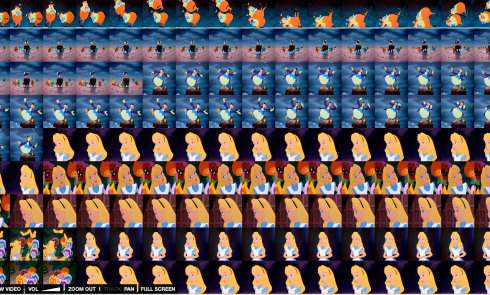
Alice In Wonderland
This will seriously make you trip out of your freaking mind. Check out this Alice In Wonderland musical masterpiece.
Hell yeah we’re in a creative revolution.
27 AugIf anyone says they’re an expert in advertising, they’re lying. Not only has the game changed. So have the rules.
Everyone’s spewing out stuff like social media is the new cool, digital this and analytics that. It’s either getting you excited or making you sick to your stomach.
However it makes you feel, I think everyone in the advertising industry can agree that we’re all on a roller coaster and none of us knows what’s going to happen next.
Personally, I love this digital explosion. I think it’s awesome I’m experiencing the next creative revolution.
Who visits your website?
13 Aug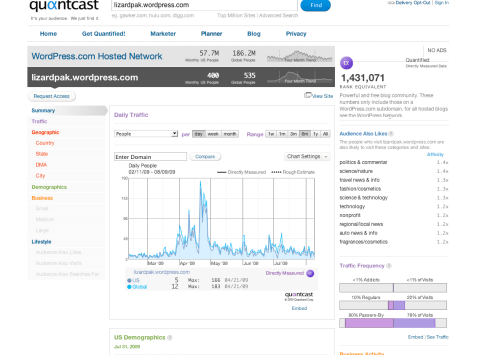
Quantcast results for lizardpak.wordpress.com
Do you know who visits your website? Are they men or women? Teens or seniors? Do they make over $100,000?
If you’re curious, check out Quantcast. Just type in your website and they’ll show you lots of details. And best of all, it’s free.
A CP+B Art Director Created Tischen
29 Jul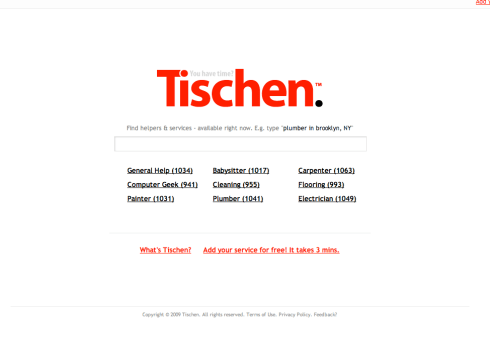
Tischen.com
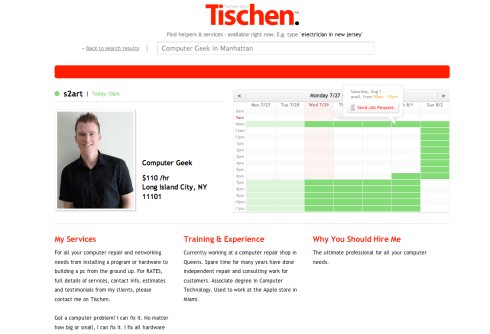
User Profile on Tischen
Tischen is a free site created by Saman Rahmanian, an art director at CP+B. Tischen lets your search for local help that are available right now for free.
Tischen is a beta and only works in NYC for now. Hopefully, more users join and see its simple user-friendly brilliance. Because I would love to use this in DC.
What I really dig about Tischen is it’s exactly what Craigslist would be if the site actually evolved. I use Craigslist a lot and whenever I do, I get so many responses every day. Sometimes, it’s takes forever to screen. What’s nice about Tischen is you get to see an actual photo of the person to make sure they’re not crazy. Users also share what services they offer, their training and experience, and then they pitch why you should hire them.
The site also shows a calendar for each user so you can see their availability today. Check out Tischen here. Or follow Saman Rahmanian on Twitter for some creative inspiration.
A beautiful and functional planner
28 JulIt’s not surprising that a place that oozes creativity would feature one of the most beautiful planners I’ve ever seen. And what makes the MOMA’s new summer planner even more cool is the fact that it’s incredibly functional. It shows you everything you need to know to plan the ultimate trip to the MOMA–including exhibits, prices, etc. And it connects to your facebook profile so you can share it with friends. Click here to try out MOMA’s new summer planner.

MOMA Summer Planner
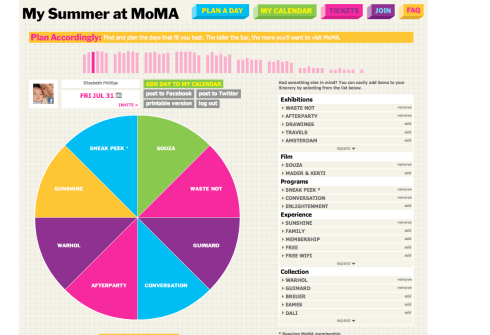
MOMA Summer Planner
Can wallpaper be cool?
24 JulI never thought it could be. Then I stumbled onto the website of Wook Kim, an Korean-born, American-raised artist. He has some mad skills. His designs are fresh. His concepts are unique. And his colors are amazing. I really love the koi fish wallpaper print, but it looks like it’s discontinued. Too bad!
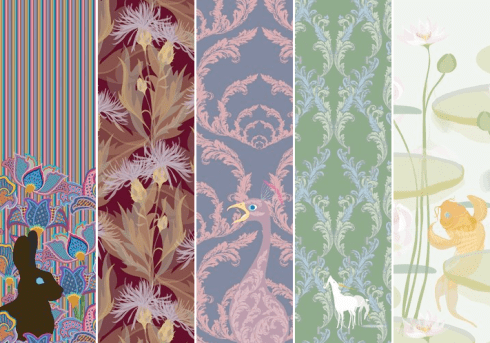
Wallpaper by Wook Kim
 euphoria meets holy crap meets badass
Comments are compliments!